4.1 Types of Assessment in Online Learning
4. Other Types of Assessment
As an instructional designer, it is crucial to understand the various types of assessments available and their appropriate uses. By using different assessment methods, educators can gather a well-rounded picture of students' knowledge, skills, and abilities. In this topic, we will explore several common types of assessments and discuss their respective uses and benefits.
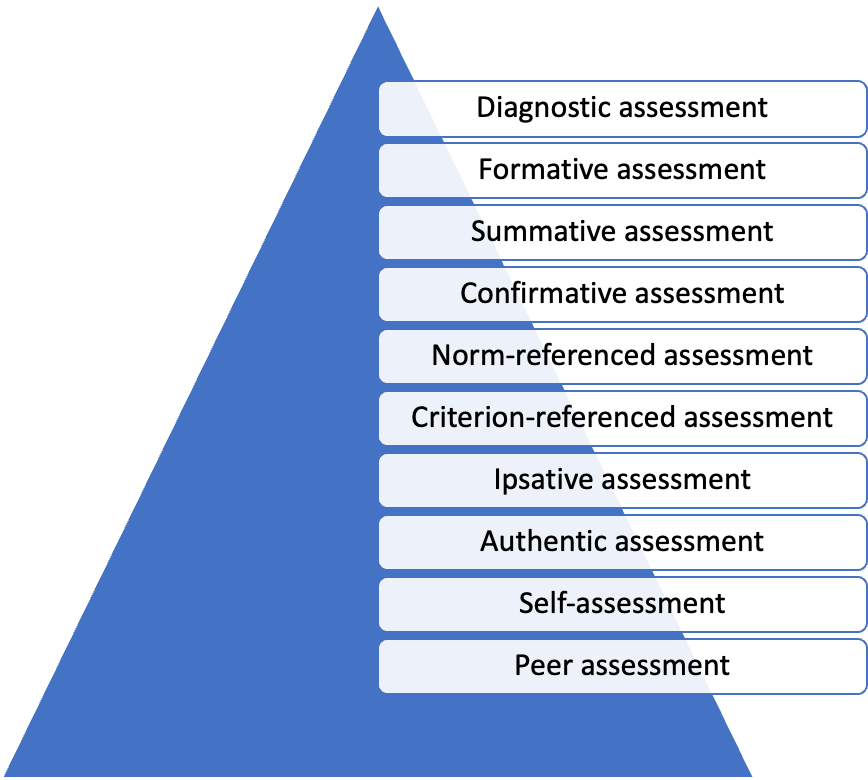
Figure 2: Types of Assessment
- Confirmative assessment. Confirmative assessment is the process of continuous improvement. They are built based on the results of formative assessment and summative assessment. They are used to analyse whether the technique that the tutors are following are still effective. After that necessary adjustments are made in the educational process to enhance the output and efficiency. If required various performance improvement programmes are conducted. A confirmative assessment ensures the success of your instructions year after year.
- Norm-referenced assessment. Norm-referenced assessment is the process of evaluating (and grading) the learning of students by judging (and ranking) them against the performance of their peers.Through norm-referenced assessments, you can determine students’ proficiency by comparing it with local, state, or national standards. In norm-referenced assessment student’s performance are compared against an average norm. This type of assessment is done to check the knowledge or skills of the students amongst a group.
- Criterion-referenced assessment. Criterion-referenced assessment measures student’s performances against a fixed set of predetermined criteria or standards of learning. The student’s performance is not compared to other students’ performance on the same assessment.
- Ipsative assessment. Ipsative assessment measures the performance of a student against previous performances from that student. Ipsative assessment support effort-based attributions, primary goal is to motivate students to learn. It is more concerned with personal achievement by increasing students’ awareness about their own learning advancement.
- Authentic assessment. Authentic assessments simulate real-world tasks and contexts, allowing students to apply their knowledge and skills in meaningful ways. These assessments often require problem-solving, critical thinking, and creativity, as they closely mirror situations students may encounter beyond the classroom. Examples of authentic assessments include case studies, projects, simulations, and performances. Authentic assessments not only assess students' understanding but also develop their transferable skills, such as collaboration and communication.
- Self-assessment. Self-assessments encourage students to reflect on their own learning and progress. By assessing themselves against predetermined criteria or learning objectives, students become more aware of their strengths and areas for improvement. Self-assessments can take the form of journals, checklists, reflection papers, or self-evaluations. By actively engaging in self-assessment, students take ownership of their learning and develop metacognitive skills necessary for lifelong learning.
- Peer assessment. Peer assessments involve students evaluating the work and performance of their classmates. By actively participating in the assessment process, students gain a deeper understanding of the criteria being assessed while also developing their own critical thinking and analytical skills. Peer assessments can be conducted through group projects, presentations, or anonymous evaluations. This type of assessment promotes collaboration, provides valuable feedback, and helps students develop a sense of fairness and objectivity.
Choosing the appropriate type of assessment depends on several factors, including learning goals, content, student characteristics, and available resources. By employing a variety of assessments, educators can gather a comprehensive and accurate representation of student learning while also supporting the development of a range of skills and abilities.