4.1 Types of Assessment in Online Learning
| Svetainė: | KTU atvirieji mokymai |
| Kursas: | Digital Education |
| Knyga: | 4.1 Types of Assessment in Online Learning |
| Spausdino: | Svečio paskyra |
| Data: | trečiadienis, 2026 liepos 15, 06:35 |
Turinys
- 1. Introduction
- 2. Importance of Assessment
- 3. Diagnostic, Formative and Summative Assessment
- 4. Other Types of Assessment
- 5. Formats of Assessment in Online Learning Environment
- 6. Understanding Assessment Design
- 7. Selecting Assessment Methods
- 8. Designing Assessment Tasks
- 9. Digital Assessment Tools
- 10. Conclusion
- 11. References
1. Introduction
In both professional and educational contexts, assessment is essential. In addition to measuring learning and performance, it also offers feedback, guarantees accountability, directs decision-making, authenticates credentials, inspires, encourages equity, permits benchmarking, and strengthens self-control. Setting and attaining goals for both individuals and organisations, encouraging ongoing improvement, and upholding high standards all depend on effective evaluation procedures.
Assessment has long been recognised by learning theories as a key component of the learning cycle. But there are several facets to the idea of learning assessment. “Assessment is the systematic collection of information about student learning, using the time, knowledge, expertise, and resources available, in order to inform decisions that affect student learning,” according to Walvoord (2010), for instance (p. 2). According to Angelo and Cross (1993), assessment is an interactive process that takes place between teachers and students to determine how successfully the former are educating the latter. Faculty members utilise the data to modify the learning environment, and students can use it to help them develop better study and learning habits.
The traditional view of assessment defines its primary role as evaluating a student’s comprehension of factual knowledge, whereas a more contemporary definition sees assessment as activities designed primarily to foster student learning (Webber, 2012).
Even though the phrases assessment and evaluation are sometimes used synonymously, it is crucial to distinguish between the two. Angelo and Cross (1993) identified some significant distinctions between assessment and evaluation. They contend that evaluation is distinct from grading. Assessment is process-oriented, continuous, diagnostic, and aimed at finding areas that require improvement in teaching and learning. Evaluation, on the other hand, determines grades based on whole performance, which includes things like effort, good behaviour, and attendance. The evaluation is final; it assigns a subjective overall grade or score and assesses the calibre of the knowledge gained.
This Lesson will provide you a grasp of the different types of assessments and their importance, enabling you to assess and improve student learning outcomes in an efficient and effective manner. We just address the assessment of learning in this Lesson; institutional assessment, course or programme evaluation, or both are not included. Within that, we limit our conversation to constructivist theory as it relates to higher education.
2. Importance of Assessment
Assessments are crucial in education as they measure learners' progress and achievements. Designing effective assessments ensures accurate and reliable evaluation of knowledge and skills acquired by learners. Learning assessment holds significant importance in the educational landscape for several reasons, aligning with pedagogical goals, instructional effectiveness, and student outcomes.
Video 1: Importance of Assessment [duration 00:48, created by the Module authors]
Key points on the importance of assessments:
- Measuring learning outcomes. Assessments provide data on whether students meet educational objectives, identifying their knowledge and skills.
- Informing instruction. They highlight student strengths and weaknesses, helping educators adjust teaching methods and improve programs.
- Facilitating reflective practice. Assessments help teachers evaluate their effectiveness and foster continuous improvement.
- Guiding student learning. Feedback from assessments helps students understand their progress and areas for improvement.
- Encouraging motivation. Regular assessments set goals, fostering a growth mindset and lifelong learning.
- Enhancing self-regulation. Self-assessment promotes autonomy and personal responsibility in learning.
- Ensuring equity. Assessments identify educational inequities, prompting supportive interventions.
- Guiding decision-making. Data from assessments informs curriculum design, resource allocation, and policy development.
- Providing accountability. Assessments ensure schools, teachers, and students meet educational standards.
- Credentialing. They validate that individuals meet specific standards for degrees and professional licenses.
- Benchmarking. Assessments allow comparisons across groups and time periods, driving improvements.
- Supporting research. Assessment data provides insights for educational research and best practices.
Assessments enhance education by measuring learning, informing improvement, providing feedback, ensuring accountability, guiding decisions, validating credentials, motivating, promoting equity, allowing benchmarking, and enhancing self-regulation. Effective assessments are key to achieving educational goals and maintaining high standards.
3. Diagnostic, Formative and Summative Assessment
The typical types of assessments are diagnostic, formative and summative assessment. Each type of assessment serves a distinct purpose, from gauging initial knowledge and skills to monitoring ongoing progress and evaluating cumulative learning outcomes. Understanding the various forms of these assessments and their applications can help educators tailor their teaching strategies to better meet students' needs, thereby enhancing the overall educational experience.
Diagnostic Assessment
Diagnostic assessment can help identify students’ current knowledge of a subject, their skill sets and capabilities, and to clarify misconceptions before teaching takes place. Knowing students’ strengths and weaknesses can help better plan what to teach and how to teach it. Types of diagnostic assessment are: a) pre-tests (on content and abilities); b) self-assessments (identifying skills and competencies); c) discussion board responses (on content-specific prompts); and interviews (brief, private, 10-minute interview of each student).
Video 2: Formative and Summative Assessment [Duration 01:06, created by the Module authors]
Formative Assessment
Formative assessment provides feedback and information during the instructional process, while learning is taking place, and while learning is occurring. Formative assessment measures student progress but it can also assess your own progress as an instructor. For example, when implementing a new activity in class, you can, through observation and/or surveying the students, determine whether or not the activity should be used again or modified. A primary focus of formative assessment is to identify areas that may need improvement. These assessments typically are not graded and act as a gauge to students’ learning progress and to determine teaching effectiveness (implementing appropriate methods and activities). Types of formative assessment are: a) observations during in-class activities; students non-verbal feedback during lecture; b) homework exercises as review for exams and class discussions; c) reflections journals that are reviewed periodically during the semester; d) question and answer sessions, both formal - planned and informal – spontaneous; e) meetings between the instructor and student at various points in the semester; f) in-class activities where students informally present their results; and g) student feedback collected by periodically answering specific question about the instruction and their self-evaluation of performance and progress.
Summative Assessment
Summative assessment takes place after the learning has been completed and provides information and feedback that sums up the teaching and learning process. Typically, no more formal learning is taking place at this stage, other than incidental learning which might take place through the completion of projects and assignments.
Rubrics, often developed around a set of standards or expectations, can be used for summative assessment. Rubrics can be given to students before they begin working on a particular project so they know what is expected of them (precisely what they have to do) for each of the criteria. Rubrics also can help you to be more objective when deriving a final, summative grade by following the same criteria students used to complete the project.
Grades are usually an outcome of summative assessment: they indicate whether the student has an acceptable level of knowledge-gain - is the student able to effectively progress to the next part of the class? To the next course in the curriculum? To the next level of academic standing? Types of summative assessment are: a) examinations (major, high-stakes exams); b) final examination (a truly summative assessment); c) term papers (drafts submitted throughout the semester would be a formative assessment); d) projects (project phases submitted at various completion points could be formatively assessed); e) portfolios (could also be assessed during it’s development as a formative assessment); f) performances; g) student evaluation of the course (teaching effectiveness); and h) instructor self-evaluation.
Assessment measures if and how students are learning and if the teaching methods are effectively relaying the intended messages. Hanna and Dettmer (2004) suggest that you should strive to develop a range of assessments strategies that match all aspects of their instructional plans. Instead of trying to differentiate between formative and summative assessments it may be more beneficial to begin planning assessment strategies to match instructional goals and objectives at the beginning of the semester and implement them throughout the entire instructional experience. The selection of appropriate assessments should also match course and program objectives necessary for accreditation requirements.
4. Other Types of Assessment
As an instructional designer, it is crucial to understand the various types of assessments available and their appropriate uses. By using different assessment methods, educators can gather a well-rounded picture of students' knowledge, skills, and abilities. In this topic, we will explore several common types of assessments and discuss their respective uses and benefits.
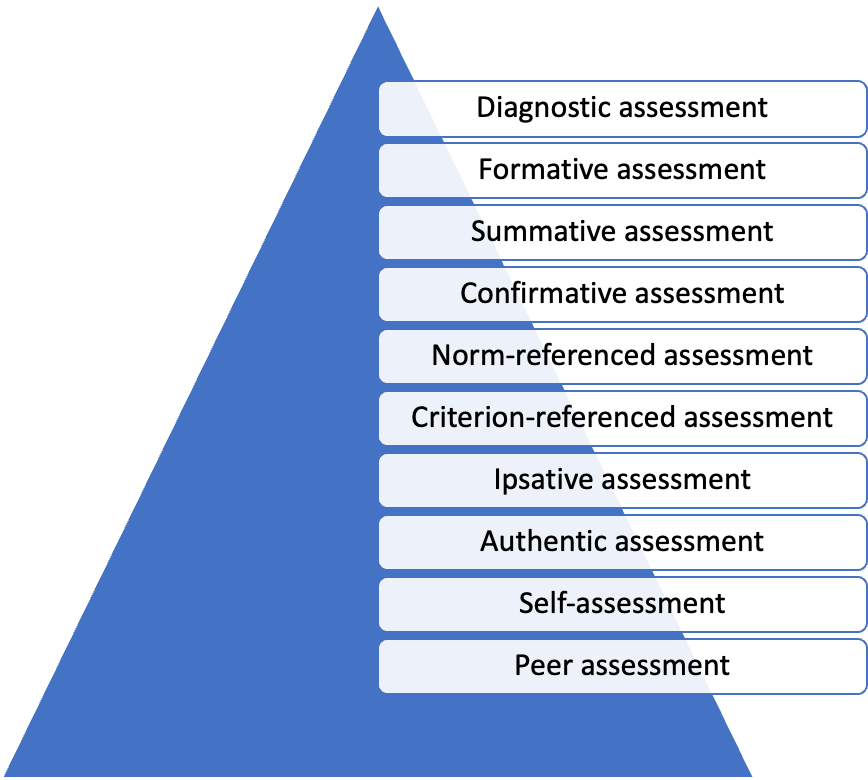
Figure 2: Types of Assessment
- Confirmative assessment. Confirmative assessment is the process of continuous improvement. They are built based on the results of formative assessment and summative assessment. They are used to analyse whether the technique that the tutors are following are still effective. After that necessary adjustments are made in the educational process to enhance the output and efficiency. If required various performance improvement programmes are conducted. A confirmative assessment ensures the success of your instructions year after year.
- Norm-referenced assessment. Norm-referenced assessment is the process of evaluating (and grading) the learning of students by judging (and ranking) them against the performance of their peers.Through norm-referenced assessments, you can determine students’ proficiency by comparing it with local, state, or national standards. In norm-referenced assessment student’s performance are compared against an average norm. This type of assessment is done to check the knowledge or skills of the students amongst a group.
- Criterion-referenced assessment. Criterion-referenced assessment measures student’s performances against a fixed set of predetermined criteria or standards of learning. The student’s performance is not compared to other students’ performance on the same assessment.
- Ipsative assessment. Ipsative assessment measures the performance of a student against previous performances from that student. Ipsative assessment support effort-based attributions, primary goal is to motivate students to learn. It is more concerned with personal achievement by increasing students’ awareness about their own learning advancement.
- Authentic assessment. Authentic assessments simulate real-world tasks and contexts, allowing students to apply their knowledge and skills in meaningful ways. These assessments often require problem-solving, critical thinking, and creativity, as they closely mirror situations students may encounter beyond the classroom. Examples of authentic assessments include case studies, projects, simulations, and performances. Authentic assessments not only assess students' understanding but also develop their transferable skills, such as collaboration and communication.
- Self-assessment. Self-assessments encourage students to reflect on their own learning and progress. By assessing themselves against predetermined criteria or learning objectives, students become more aware of their strengths and areas for improvement. Self-assessments can take the form of journals, checklists, reflection papers, or self-evaluations. By actively engaging in self-assessment, students take ownership of their learning and develop metacognitive skills necessary for lifelong learning.
- Peer assessment. Peer assessments involve students evaluating the work and performance of their classmates. By actively participating in the assessment process, students gain a deeper understanding of the criteria being assessed while also developing their own critical thinking and analytical skills. Peer assessments can be conducted through group projects, presentations, or anonymous evaluations. This type of assessment promotes collaboration, provides valuable feedback, and helps students develop a sense of fairness and objectivity.
Choosing the appropriate type of assessment depends on several factors, including learning goals, content, student characteristics, and available resources. By employing a variety of assessments, educators can gather a comprehensive and accurate representation of student learning while also supporting the development of a range of skills and abilities.
5. Formats of Assessment in Online Learning Environment

There are many formats of assessment in online learning environments. Some examples include:
- Case studies prompt students to put concepts, theories, and policies into a specific context and support the development of critical thinking skills, allow students to learn from one another, and encourage practical reasoning while generating strategies and solutions to real issues.
- Reflections. Critical reflection essays are often written at the end of a course as an opportunity for students to look back on their learning throughout the course. Embedding a reflective component within other assignments allows to gauge how learning is developing through these tasks.
- Infographics develops students critical thinking and communication skills. Infographics make great assignments when needed to make connections, discern the most relevant information, and communicate it in a different way.
- Online discussions. Thoughtful discussion prompts allow students to explore course concepts, gain new perspectives and understanding, participate actively and collaboratively in online courses.
- Online student presentations, whether live or pre-recorded, allow students to express their learning in different modes – spoken words, gestural expression, and often with images/visual aids. Students learn the skills of verbal expression and knowledge translation
- Podcast assignments allow students to demonstrate their learning in a different mode; students can expand on traditional knowledge generation and translation approaches by using strategies such as including portions of interviews, adding relevant sounds, music, etc.
- Open book exams. Open book, or open resource, exams provide dynamic opportunities for students to connect course materials with their previous learning by analyzing, synthesizing, critiquing, and/or evaluating information; require students to connect course material to solve real-world scenarios or problems.
- Annotated bibliography provides students with the opportunity to strengthen skills in finding appropriate research literature, reading critically to assess the contributions of various articles, and writing concisely and coherently for a broader academic audience.
- Media critique critiquing a current media source can be a meaningful learning experience that allows students to make connections between their daily lives and course content.
- E-portfolio process of selecting the best examples of learning in a course or program can be illuminating as students see how far they have come; learning becomes visible as students organize artifacts that showcase their knowledge and skills.
- Learning journal students are required to write critically about what they have learned, drawing upon their experiences and/or practice, and relating it to their reading; enabling students to demonstrate complex learning outcomes including critical thinking.
In conclusion, assessment is an important part of the cycle of learning, which also includes outcomes (what?), strategies (how?), and content. Assessment is an integral part of the planning process and must coalesce with all other aspects of the intended learning experience, whether in terms of course or program. Assessment permits learners to engage with open-ended tasks that sustain learning and the learning cycle. Assessment presents learners with opportunities to make connections with prior knowledge and to build relationships between their own learning.
6. Understanding Assessment Design
Assessment design refers to the deliberate and systematic process of creatingassessments that align with desired learning outcomes. It involves selectingappropriate assessment methods, developing suitable tasks or questions,establishing grading criteria, and ensuring validity and reliability of theassessments.
Key Considerations in Assessment Design
When designing assessments, several factors need to be taken into account toensure their effectiveness. These include:
- Alignment with Learning Outcomes. Assessments should be closely aligned with the intended learning outcomes of acourse or training program. This alignment ensures that the assessment measures what it is intended to measure and provides a reliable indicator of learner achievement.
- Validity. Assessments should possess validity, which means they accurately measure theknowledge or skills they are intended to assess. Validity can be established through careful consideration of the content and format of the assessment, as well as the expertise of subject matter experts.
- Reliability. Reliability refers to the consistency and stability of assessment results. Designersshould aim to create assessments that yield consistent results when administeredmultiple times under similar conditions. Reliability can be enhanced through well-defined grading criteria and training of assessors.
- Authenticity. Authentic assessments reflect real-world situations and tasks that learners arelikely to encounter in their future endeavors. Designing assessments that align with real-life contexts helps ensure that learners can transfer their acquired knowledge and skills effectively.
- Engagement.Engaging assessments capture learners' interest and motivate them to demonstrate their knowledge and skills to the best of their abilities.Incorporating interactive elements, real-life scenarios, and multimedia can enhance engagement and lead to a more accurate assessment of learners' capabilities.
- Balance. A well-designed assessment should strike a balance between various assessmentmethods, such as formative and summative assessments, as well as differenttypes of tasks or questions. This balance ensures a comprehensive evaluation oflearners' progress and learning outcomes.
7. Selecting Assessment Methods
There are various types of summative assessment methods and tools, each with its own advantages and challenges. Designers need to consider diverse assessment methods and tools that suit the specific learning outcomes they aim to measure. Some common assessment methods include:
- Written Assessments: These include essays, short-answer questions, and multiple- choice questions. They are useful for evaluating learners' understanding of theories, concepts, and factual knowledge.
- Performance Assessments: These require learners to apply their knowledge and skills in real or simulated scenarios. Performance assessments can involve practical tasks, presentations, portfolio assessments, or simulations.
- Oral Assessments: Oral assessments involve interviews, debates, presentations, or discussions. They allow for the evaluation of learners' oral communication skills, critical thinking abilities, and ability to articulate their ideas effectively.
- Observational Assessments: These assessments involve direct observation of learners' performance, such as in laboratory experiments, simulations, or workplace settings. They ensure a comprehensive evaluation of learners' practical skills.
Video 3: Assessing Online Learning: Introduction to Online Assessment [2:26]
Traditional Summative Assessment Tools
- Examinations: These include multiple-choice tests, short answer questions, and essay exams. They are widely used due to their ease of administration and scoring.
- Standardised Tests: These are norm-referenced tests that provide comparative data on student performance across different institutions.
Performance-Based Tools
- Projects: These involve complex, multi-step tasks that integrate knowledge and skills.
- Portfolios: These are collections of student work that demonstrate learning progress and achievement over time.
- Presentations: These assess students' ability to articulate their knowledge and skills verbally and visually.
Alternative Tools
- Peer Assessments: These involve students evaluating each other's work, promoting critical thinking and self-assessment skills.
- Self-Assessments: These encourage students to reflect on their own learning and identify areas for improvement.
8. Designing Assessment Tasks

After selecting an appropriate assessment method, designers need to create tasks or questions that accurately measure the desired learning outcomes. Some key considerations in task design include:
- Clear Instructions: Tasks should provide clear instructions to prevent ambiguity andconfusion among learners. Well-defined instructions help learners understand the purpose, requirements, and expectations of the assessment.
- Authenticity: Tasks should be authentic and relevant to the real-world application ofknowledge and skills. They should mirror the challenges learners may encounter in their future professional contexts.
- Appropriate Difficulty: Tasks should be appropriately challenging and match theintended cognitive level of the learning outcomes. Tasks that are too easy or too difficult can lead to inaccurate assessments of learners' abilities.
- Variety: Designers should consider incorporating a variety of tasks or questions thatassess different aspects of the learning outcomes. This variety ensures acomprehensive evaluation and prevents over-reliance on a single assessment method.
- Time Considerations: Tasks should be designed with realistic time constraints tomirror real-life situations in which learners must complete tasks within a giventimeframe.
Designing effective assessments requires careful consideration of various factors such as alignment with learning outcomes, validity, reliability, authenticity, engagement, and balance. The selection of appropriate assessment methods, thoughtful design of assessment tasks, and establishment of clear grading criteria contribute to accurate and reliable assessment outcomes. By designingassessments that effectively measure learning outcomes, educators and trainerscan gain valuable insights into learners' progress and facilitate their continued growth and development.
Establishing Grading Criteria
Grading criteria provide a clear framework for evaluating learner performance and assigning grades or scores. Key considerations in establishing grading criteria include:
- Alignment with Learning Outcomes: Grading criteria should align closely with the intended learning outcomes, ensuring that learners' achievements are accurately assessed.
- Clarity and Objectivity: Grading criteria should be clear, specific, and objective to minimize subjectivity and ensure consistent grading across multiple assessors.
- Differentiation of Achievement Levels: Grading criteria should allow for differentiation of achievement levels, enabling the identification of learners' strengths and areas for improvement.
- Weighting of Assessment Components: Grading criteria should reflect the relative importance of different assessment components to ensure a fair and balanced evaluation.
9. Digital Assessment Tools



There are a variety of digital tools that can make summative assessments easier. For example,
- Socrative. For a comprehensive suite of technological tools tailored for student assessment, this platform offers a diverse array of options. It supports the inclusion of multiple-choice, true/false, and short-answer questions, enhancing the flexibility of assessment formats. Notably, the platform allows instructors to view student results in real time, which facilitates immediate insight into student performance. Additionally, it provides the capability to add explanatory notes for incorrect answers, fostering a deeper understanding among students.
- Floop. Regardless of the grade level or subject matter, the grading process often demands significant time and effort, which educators frequently find in short supply. Introducing Floop, a cloud-based platform designed to streamline the feedback process. This tool enables students to receive detailed, annotated feedback from both instructors and peers. Students can upload images of their assignments using any internet-connected device, facilitating ease of access and use. Instructors can then annotate these images, placing markers at specific points to provide targeted feedback. This system allows students to view and respond to comments, thereby establishing a continuous feedback loop that enhances learning and comprehension.
- Naiku. Efficiently develop quizzes that students can complete using their mobile devices with this program. Additionally, it features a comprehensive repository of 60,000 standards-aligned question items and 300 pre-constructed assessments, providing extensive resources to facilitate the creation of robust and aligned evaluations.
- Students benefit from instant feedback, which can be configured to suit various instructional approaches; quizzes can be set to self-paced mode or conducted in a teacher-led format. A particularly commendable feature is the "Space Race," a collaborative quiz activity wherein student groups compete to reach the finish line, thereby promoting engagement and interactive learning.
- Seesaw. Portfolios serve as an excellent tool for summative assessment, enabling educators, students, and families to review a curated collection of student work and assess developmental progress over time. Traditional paper portfolios, however, are susceptible to being misplaced and present challenges in terms of sharing and grading. An effective alternative is to utilize an online portfolio platform, such as Seesaw, which mitigates these issues by providing a digital solution that is easily accessible, shareable, and more convenient for evaluative purposes.
- Book Creator. This represents an alternative form of portfolio assessment. Instead of merely aggregating their work over time, students utilize the program to actively construct a digital compendium that illustrates their learning outcomes.
Several digital formative assessment tools can be used:
- Google Forms for Exit Tickets. Exit tickets represent an excellent strategy for assessing students' comprehension of the day's lesson. To modernize this approach by replacing traditional sticky notes with a digital alternative, consider utilizing Google Forms. This platform is user-friendly and provides a convenient means of accessing student responses from any location at any time, thereby enhancing the efficiency and accessibility of formative assessments.
- Kahoot! This complimentary online quiz-game generator has gained widespread popularity, and justifiably so. Educators present the questions while students utilize a secure application on their personal devices, such as Chromebooks or smartphones, to submit their responses. These interactive games are highly engaging for students, making them an effective tool for enhancing classroom participation. Post-game, educators can analyze detailed reports to identify areas where students may require further instruction, thereby facilitating targeted remediation and mastery of learning objectives.
- CommonLit. CommonLit offers an extensive, free library of reading passages, each accompanied by integrated quizzes designed to assess comprehension. Educators can select articles based on topic, reading level, or genre, and assign them to students. The platform allows students to annotate texts and engage with guided reading questions as they progress through the material. Following their reading, students complete a comprehension quiz and participate in discussion questions, thus reinforcing their understanding and promoting critical thinking.
- Flip. Flip (formerly known as Flipgrid) is a video discussion platform modeled after social media, designed to facilitate class discussions on various topics, videos, or links posted to the class grid. Students can record video responses and share them with the teacher or the entire class. This platform is particularly effective for encouraging students to articulate and visualise their thought processes, thereby enhancing engagement and comprehension through interactive discourse.
- Mentimeter. Mentimeter is a dynamic tool that enhances presentations by incorporating interactive elements such as polls, word clouds, Q&A sessions, and more. This platform enables students to actively participate by voting on or responding to questions in real time, thereby fostering an engaging and interactive learning environment. The diverse range of formative assessments available through Mentimeter, administered instantaneously, is a key reason for its inclusion on our recommended list of educational technologies.
- Jamboard. Jamboard is a digital whiteboard seamlessly integrated with Google Workspace (formerly G Suite) services. It significantly enhances the focus on the learning process rather than solely on the final product. This tool is particularly favored by mathematics educators, as it allows students to solve problems and articulate their solutions effectively. For those not utilizing Google services, Padlet serves as a commendable alternative.
- Literably. Students can read aloud and respond to questions directly on their devices, with compatibility extending to nearly all types of devices. Within a 24-hour period, educators receive a running record that includes scores for accuracy, fluency, and comprehension. The free basic account provides access to 10 reading assessments per month.
- Edpuzzle. Edpuzzle is a versatile video editing tool that enables both educators and students to incorporate voice-overs, comments, supplementary resources, and quizzes into existing or self-created online videos. The most advantageous feature is the automatic collection of student responses, allowing educators to efficiently assess student understanding and engagement.
- Pear Deck. Pear Deck is an interactive presentation and lesson delivery tool designed to enhance student engagement. Using their devices, students can follow along with the teacher's slideshow displayed on a classroom screen. Throughout the presentation, teachers can pause at designated points to pose interactive questions, thereby collecting real-time data on student comprehension and understanding.
- Quizalize. The quizzes are meticulously tagged to educational standards, enabling educators to efficiently track mastery data for every question answered. These quizzes support a range of official state standards, including Common Core, TEKS, and others. Additionally, educators have the option to add hints or explanations, facilitating student learning as they complete the assessments.
10. Conclusion
In conclusion, this Lesson provides a comprehensive overview of the principles and strategies involved in creating effective assessments. Through an Introduction to Designing Assessments, learners gain an understanding of the importance of assessments and their role in measuring learning outcomes. The exploration of Types of Assessments and their uses equips participants with knowledge on various assessment methods such as formative and summative assessments, enabling them to choose the most appropriate approach based on the learning objectives. Finally, the module emphasizes the significance of validity and reliability in assessment design. Overall, this Lesson equips learners with the essential skills and knowledge needed to design assessments that promote effective learning and evaluation.
11. References
Angelo, T, & Cross, K. P. (1993). Classroom Assessment Techniques: A Handbook for College Teachers. San Francisco, CA: Jossey-Bass.
Blândul, V., & Bradea, A. (2022). Developing student self-assessment competences in the online learning environment amid the COVID-19 pandemic. In V. Trif (Ed.), Basic Communication and Assessment Prerequisites for the New Normal of Education (pp. 140-161). IGI Global. https://doi-org.ezproxy.tlu.ee/10.4018/978-1-7998-8247-3.ch009
Conrad, D., & Openo, J. (2018). Assessment Strategies for Online Learning: Engagement and Authenticity.Athabasca University Press. doi: 10.15215/aupress/9781771992329.01
Conrad, D., & Witthaus, G. (2021). Reimagining and reexamining assessment in online learning. Distance Education, 42(2), 179-183.
Hanna, G. S., & Dettmer, P. A. (2004). Assessment for Effective Teaching: Using Context-Adaptive Planning. Boston, MA: Pearson A&B.
Morris, R., Perry, T., & Wardle, L. (2021). Formative assessment and feedback for learning in higher education: A systematic review. Review of Education, 9(3), e3292.
Rust, C., O’Donovan, B., & Price, M. (2005). A social constructivist assessment process model: How the research literature shows us this could be best practice. Assessment & Evaluation in Higher Education, 30(3), 231–240. doi: 10.1080/02602930500063819
Stödberg, U. (2012). A research review of e-assessment. Assessment & Evaluation in Higher Education, 37(5), 591–604.
Vaughan, N. D., Cleveland-Innes, M., & Garrison, D. R. (2013). Teaching in blended learning environments: Creating and sustaining communities of inquiry. Edmonton, AB: Athabasca University Press. Retrieved from http://www. aupress.ca/books/120229/ebook/99Z_Vaughan_et_al_2013-Teaching_in_ Blended_Learning_Environments.pdf
Webber, K. L. (2012). The use of learner-centered assessment in US colleges and universities. Research in Higher Education, 53(2), 201–228. doi:10.1007/s11162- 011-9245-0