
Lesson 2.3 Pedagogical Approaches for Online Teaching
3. Developing Active Learning
Active learning is particularly important in online education, where students aren’t in the same location as their peers. Instructors should start thinking about active learning from the moment they start planning their online learning materials and incorporate strategies to encourage active learning, application, interaction, participation, and collaboration in the online environment. In an active learning environment, learners are immersed in experiences within which they engage in meaning-making inquiry, action, imagination, invention, interaction, hypothesizing and personal reflection (Cranton, 2012).
Active learning is about what the student does rather than what the teacher does (OU, n.d.). Most of the activities should be designed to prompt students not simply to read, see or listen to information but to search for it, process it, discuss it, present it, reflect on it, and apply it in real or simulated scenarios to which they can relate. Incorporating active learning in online learning environments is crucial because it includes collaboration, exchanging ideas, and fostering an inclusive environment.
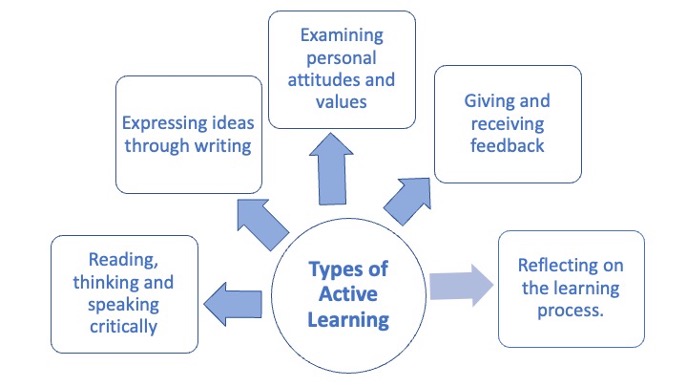
Figure 1: Types of Active Learning
There are a variety of active learning strategies described in the literature. Many university websites provide lists, guides, and resources for active learning strategies:
- Iowa State University Center for Excellence in Learning and Teaching presents 226 Active Learning Strategies;
- Purdue University offers Active Learning Strategies and Resources;
- University of Leicester active learning strategies.