
Lesson 1.3 Benefits and Challenges of Digital Education
2. Benefits of Digital Education
The main benefits of digital education are:
- Accessibility
- Flexibility
- Engagement
- Cost-effectiveness
- Global collaboration
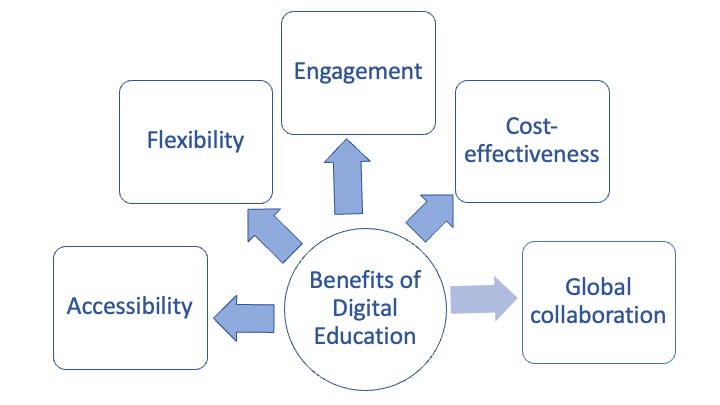
Figure 1: Benefits of Digital Education
Accessibility: Digital education breaks down physical barriers to learning. It allows individuals to access educational resources and materials from anywhere with an internet connection, regardless of geographical location or physical limitations. This accessibility is particularly advantageous for people in remote areas, those with disabilities, or individuals who cannot attend traditional classrooms due to work or family commitments.
Flexibility: Digital education offers flexibility in terms of scheduling and pacing. Learners can access course materials at any time that suits them, allowing them to study around their existing commitments. Additionally, digital platforms often offer self-paced learning options, allowing students to progress through courses at their own speed, accommodating different learning styles and preferences.
Engagement: Digital education leverages various interactive tools and multimedia resources to engage learners in ways that traditional methods often cannot. Through videos, simulations, interactive quizzes, and online discussions, students can actively participate in their learning process, leading to deeper understanding and retention of knowledge. Furthermore, digital platforms can adapt content to individual learning needs, providing personalised learning experiences that keep students engaged and motivated.
Cost-effectiveness: Digital education can be more cost-effective than traditional forms of education. It eliminates the need for expenses associated with physical infrastructure, such as classrooms and textbooks. Additionally, it reduces travel costs for both students and instructors. Moreover, digital materials can often be distributed at a lower cost compared to printed materials, making education more affordable and accessible to a wider range of learners.
Global collaboration: Digital education fosters collaboration among students and educators from around the world. Through online forums, video conferencing, and collaborative tools, learners can connect with peers and experts regardless of their location. This global collaboration exposes students to diverse perspectives and experiences, enriching their learning journey and preparing them for an increasingly interconnected world. Furthermore, digital platforms enable international partnerships between educational institutions, allowing for the exchange of knowledge, resources, and best practices on a global scale.
Overall, digital education offers numerous benefits that enhance accessibility, flexibility, engagement, cost-effectiveness, and global collaboration, ultimately democratising access to quality education and empowering learners to succeed in the digital age.