
Key aspects of project management
Project management cycle
The project management life cycle includes the stages (of activities) that normally occur in a project, helping to implement the project idea into reality in an organized way. Each project includes stages (see Figure 2):
- Preparation (Initiation)
- Planning
- Execution
- Closure
At the same time, monitoring and controlling activities are carried out at each stage.
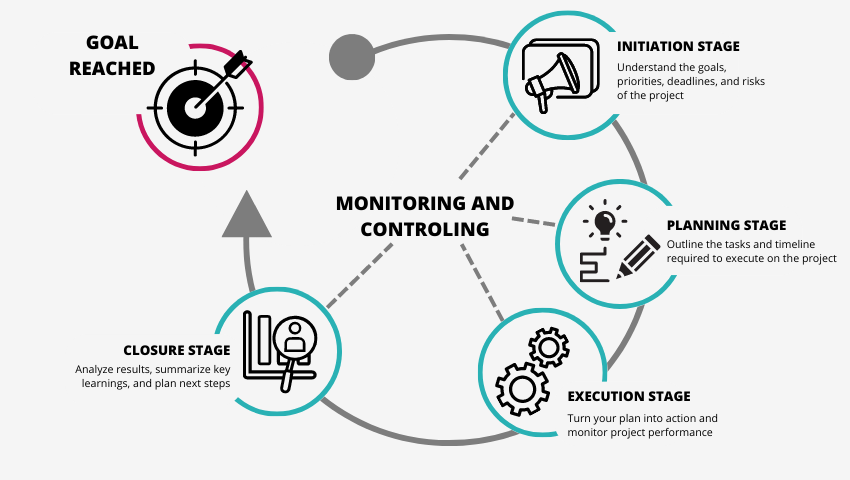
Fig. 2. Project
management cycle (Nediger, 2019)
Research projects can have two types of management. Both of them are aimed at achieving the final results of the project with the given resources and time frame, only one focuses on the research process side, the other on the organizational and administrative side. It is most effective if both manage to cooperate well: the main leader of the project - the initiator or researcher of the study and the professional project manager (MEOPAR, 2020). Although not all cases can afford to bring in a project management professional, one can learn and use the knowledge, skills, methods and techniques from this field (which is highly developed in the business industry) (Howard Hughes Medical Institute, Burroughs Wellcome Fund, 2006).
Community involvement is the most essential aspect of Citizen Science projects. It is best to start involving the public already at the initiation of the project or in the preparation stage. Community involvement in each subsequent stage of the project cycle needs to strengthen and expand. During the preparation stage, the project organizers will most likely address and will get feedback from people they already know and who are active in the community (World Bank Group, 2019).
We can look more broadly at the management cycle of the research project. A research project requires a considerable amount of work and time to be invested in the pre-project stage, where the initiator and developer of the idea, the project writer, play the role of manager. If you managed to find a financier interested in the project and obtain funding, then depending on the situation for the duration of the project implementation, you can attract a professional project manager who would focus himself and the team on achieving results within the terms promised in the project application (in that case, the initiation stage for the project manager would start with the project application dating). With or without a professional project manager, the next stage, after concept preparation and approval, is related to the preparation of detailed activity implementation plans in various contexts (schedule, research methodology, risks, communication and citizen engagement, visibility, etc.).
After that, the implementation of the project activities takes place, in parallel with monitoring, control and decision-making for adjusting the progress of the project activities according to the current situation in order to achieve the milestones and the final goal (see Figure 3).
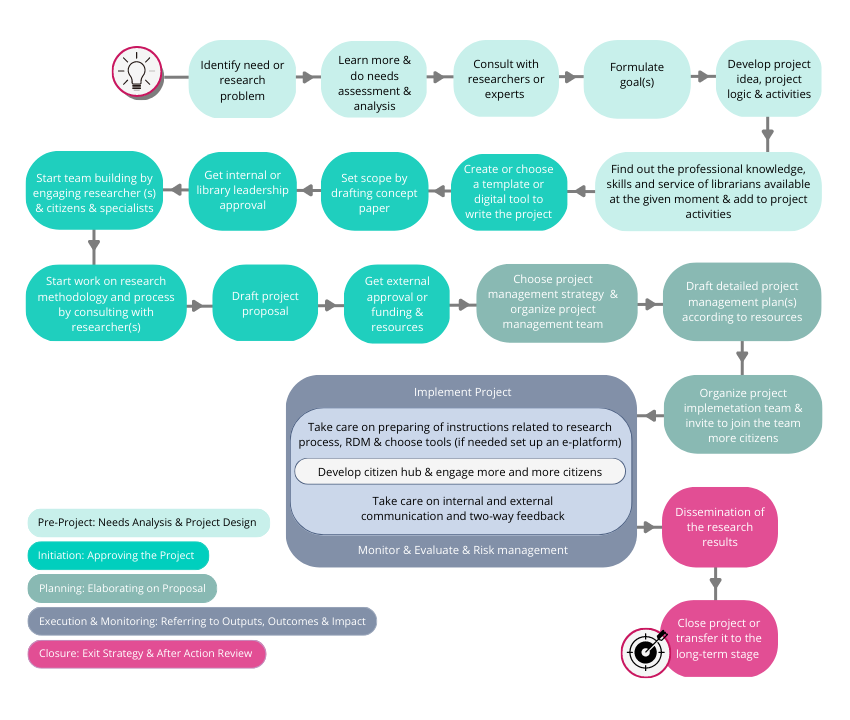
Fig. 3. Research
project life cycle with project management stages (Tabsh, 2012; Letouze, 2011)
At the planning stage, it is important to find out the opinion of all the parties involved, the potential opportunities for cooperation and willingness to participate in devoting their time to research activities. Implementation stage should use a wider range of methods to stimulate interest and new participants involvement, as well as good awareness of the progress of the project among existing participants. Exchange of experience and celebration of achievements should be planned during the closure stage.
A successful Citizen Science project is based on an actively involved society and individuals who manage knowledge, resources, finances and political processes, effective and sustainable cooperation and precisely identified problems. After identifying the problem, it is necessary to develop a concept and then organize its discussion. After receiving feedback and a positive response from the interested parties, the work on the development and organization of the project begins.