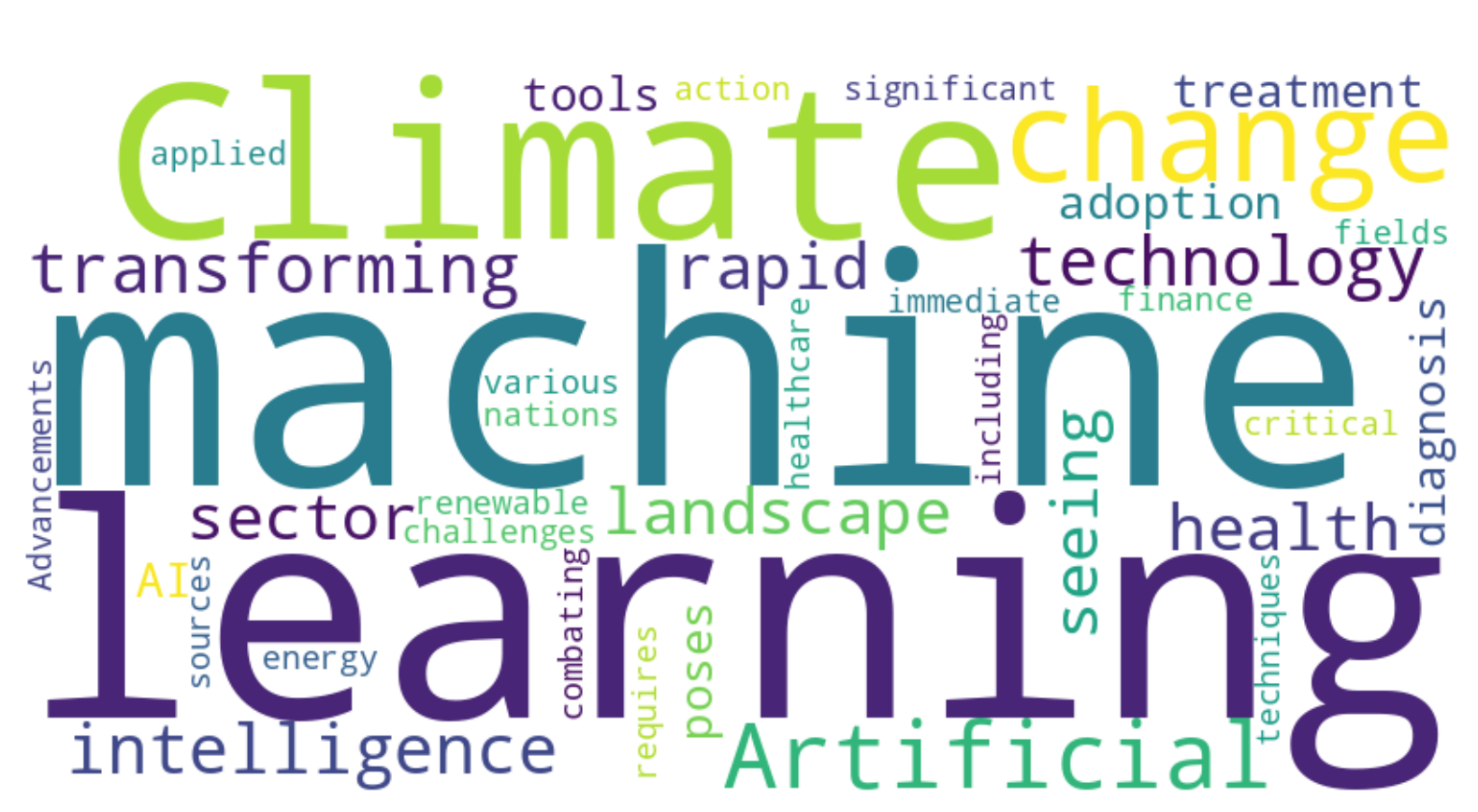
Corpus Selection: I selected a collection of recent news articles about climate change. I chose this corpus to understand the main themes and concerns being discussed in the media regarding this critical issue.
Text Cleaning: I used Python's BeautifulSoup library to remove HTML tags and regular expressions to eliminate special characters and formatting. One challenge I faced was dealing with different encodings in the text files, which I resolved by standardizing all texts to UTF-8.
Data Preparation:
I loaded the cleaned texts into a .csv file with two columns: ID for the document identifier and Content for the raw text. Here's a snippet of my .csv file:
| ID | Content |
|---|---|
| 1 | "Climate change is causing more frequent and severe weather events around the world." |
| 2 | "Renewable energy adoption is key to mitigating climate change effects." |
Topic Modeling Analysis: Following the tutorial, I removed stop words, performed lemmatization, and tokenized the text. I set the number of topics to 5 for the LDA model, which I found to provide a good balance between granularity and interpretability.
Visualizations:
Insights: The predominant topics were:
- Climate Change Effects: Discussing impacts like severe weather events.
- Renewable Energy: Focus on the adoption and benefits of renewable sources.
- Policy and Regulation: Conversations around government policies and international agreements.
- Technological Innovations: New technologies being developed to combat climate change.
- Public Awareness and Activism: The role of public awareness campaigns and activism.
I was surprised to see a significant amount of discussion on technological innovations, indicating a strong focus on finding new solutions.