4.3. Open Digital Badges
| Svetainė: | KTU atvirieji mokymai |
| Kursas: | Digital Education |
| Knyga: | 4.3. Open Digital Badges |
| Spausdino: | Svečio paskyra |
| Data: | trečiadienis, 2026 liepos 15, 06:36 |
1. Introduction
Open digital badges are a type of digital credential used to recognize and verify the acquisition of specific skills, knowledge, or achievements. They serve as an alternative to traditional forms of assessment and credentialing, offering a flexible and accessible way to validate and showcase competencies.
There are several definitions of Open or Digital Badges. Mozilla Foundation (Mozilla Foundation, 2012) defines Open Badges as “a symbol or indicator of an accomplishment, skill, quality or interest used to set goals, motivate behaviours, represent achievements and communicate success in many contexts”. Grant (2016, p. 3) defines Open Badges as „digital image files that contain metadata, and their origins are inseparable from the ethos of open source code and software protocols “. Liyanagunawardena et al. (2017) define Open Badges as “a digital representation of skills or accomplishments recorded in a visual symbol that is embedded with verifiable data and evidence. They are created following a defined open standard, so that they can be shared online”.
Thus, Open Badges, also referred to as Digital Badges or Educational Badges, are visual symbols or digital representation of knowledge and skills, learning achievements or experience for certifying and recognising learning acquired from different educational providers, and packed with data and evidence that can be shared across the web. While a Digital Badge is an online representation of a skill the learner has earned, Open Badges take that concept one step further, and allow learners to verify their skills, interests and achievements through credible organisations (Virkus, 2019).
On its surface, a badge is nothing more than an image file encoded with metadata such as which organisation awarded it, the name and description of the badge, what skill, competency or achievement the badge represents, the criteria for earning the badge, the date of issue, if and when it expires, and links to evidence for why it was awarded. With support from the MacArthur Foundation, Mozilla developed an Open Badges Infrastructure (OBI), an open standard that was released in 2012. The OBI is a key element in the adoption and success of an ecosystem of badges, designed to support a broad range of different badge issuers, and to allow any user to earn badges across different issuers, web sites and experiences, and then combine them into a single collection tied to their identity (Virkus, 2019).
Video 1: Open Digital Badges [duration 2:00, created by the Module authors]
Video 2: What is a Badge? [2:44}
Video 3: What are Open Digital Badges? [5:36}
2. Goals and Roles of Open Digital Badges
The role of badges as competency credentials and as bridges from informal to formal learning increase the potential of open badges for changing teaching, learning and assessment processes. One potential for open badges is to award credentials for alternative forms of learning experiences acquired outside formal education settings. Hickey (2012a, para. 3) identifies three types of primary goals for using badges:
- showing what somebody has done or might be able to do,
- motivate individuals to learn or do and
- transform or create learning systems.

Image Source: Bryan Mathers image collection
Gibson et al. (2016, p. 16) outline three primary roles of Open Badges for supporting learning journeys in higher education:
- bringing visibility and transparency to learning, teaching and assessment;
- revealing meaningful, identifiable and detailed aspects of learning for all stakeholders;
- providing a new mechanism to recognise skills, experience and knowledge through an open, transferable, stackable technology framework (Virkus, 2019).
Joseph (2012) presents six frameworks for examining digital badging for learners to explain why people align themselves with badges and what their goals are in using badges. The six frameworks include:
- badges as alternative assessment;
- gamifying education with badges;
- badges as learning scaffolding;
- badges to develop lifelong learning skills;
- badges as digital media and learning driver, and
- badges to democratise learning.
These are the main reasons for using Open Digital Badges as reflected in the literature (Virkus, 2019).
3. Characteristics of Open Digital Badges
Many of the characteristics of Open Digital Badges make them well suited to support personalised ways of learning and allow learners to choose their own pathways through learning content.
Open Digital Badges are:
- free and open: a free software and an open technical standard allow any organisation to use, create, issue and verify Open Digital Badges;
- transferable: badges earned in one environment can be shared in another - they can be transferred from one backpack to another and from one online platform to another;
- stackable: badges from one organisation’s system can build upon ones from another system and be stacked to tell the full story of learner’s skills and achievements;
- evidence-based: each badge has metadata which is hard-coded into the badge image file that links back to the issuer, criteria and verifying evidence (Mozilla, 2019, para. 3).
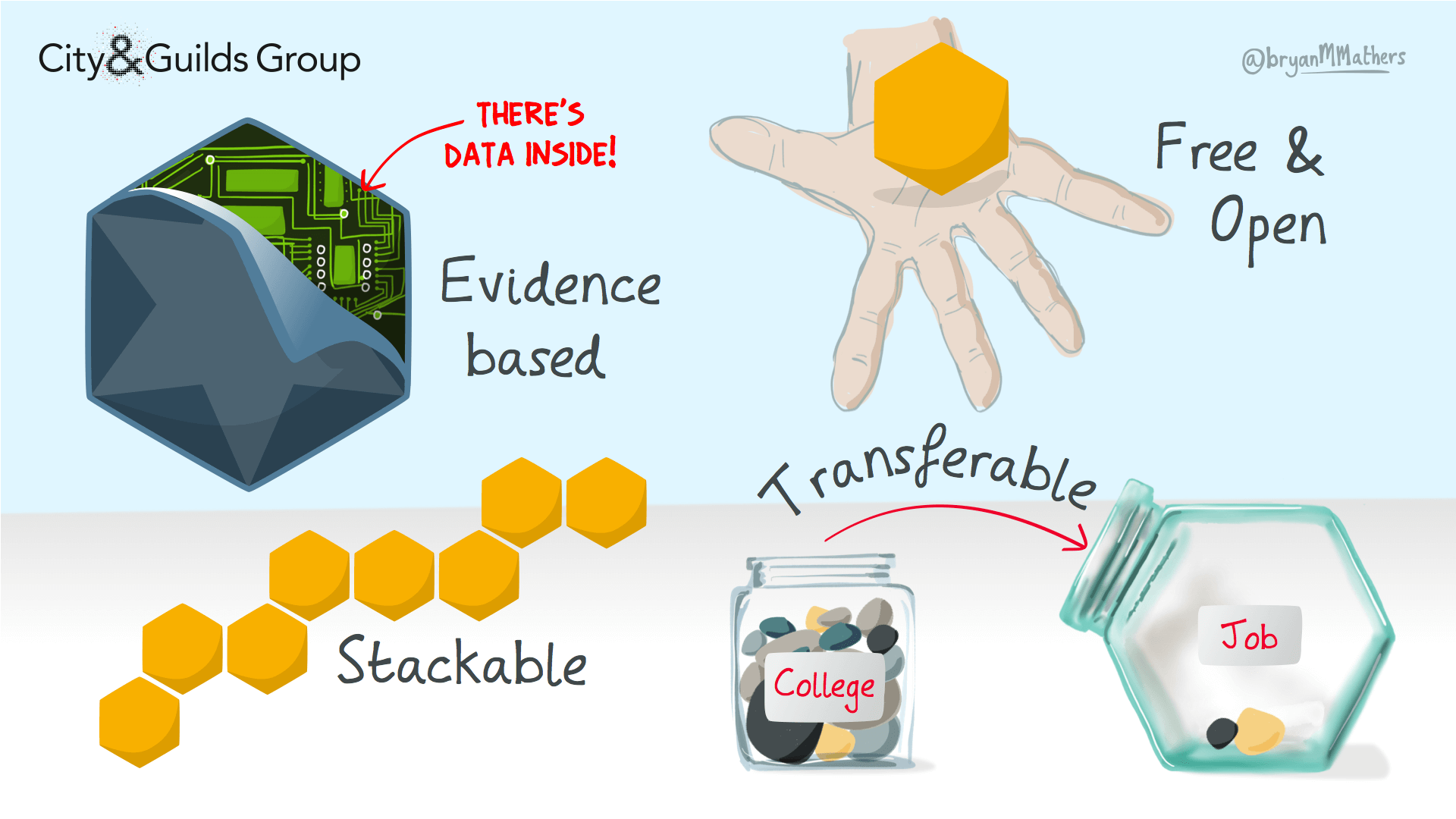
Image Source: Bryan Mathers image collection
Goldberg adds transportability and the granularity. Transportability refers to the ability of the badge to follow the badge earner through his lifetime and be recognised in a variety of environments. Granularity emphasises the need for specific data and details about why and how the badge was earned, so that anyone viewing it will have a clear understanding of the competencies of the badge owner (Virkus, 2019).
4. Functions of Open Digital Badges
Hickey (2012b) outlines four major functions for Open Digital Badges: recognising learning, assessing learning, motivating learning and evaluating learning.
(1) Recognising learning - this is the primary function of badges as they can capture various skills and achievements and provide a detailed picture of learners’ skills, experience, achievements and qualities;
(2) Assessing learning - according to Hickey (2012a) assessing learning is one of four major functions for Open Digital Badges. Badges can help: (1) drive innovation around new types of assessments; (2) provide more personalised assessments for learners and (3) move beyond out of date or irrelevant testing practices. However, there are multiple assessment options for earning a badge and ensuring that the needs of each learner are met including course organisers, peers, or learners themselves. Nearly every application of Open Digital Badges includes some form of assessment: for example, summative, formative, transformative, instructor-, peer-, and self-assessment (Hickey 2012a, 2012b);
(3) Motivating learning - much of the concern and applause for badges centres around the idea of motivation. Some authors believe that badges are motivating students because of its playful nature. However, there are concerns about the well-documented negative consequences of extrinsic incentive on intrinsic motivation and free choice engagement. Therefore, some authors argue that we should not use badges to motivate learning. However, Hickey (2012b, para. 7) notes, that if we use badges to recognise and assess learning, they are likely to impact motivation.
(4) Evaluating learning - badges have enormous potential for helping teachers, schools, and programs evaluate and explore learning. Each badge has eight bits of information (“metadata”) which will be recorded and easily accessible as a database (Virkus, 2019).
Video 3: Get Started with Digital Badges! [10:48]
5. Advantages of Open Digital Badges
Open Digital Badges offer several advantages for learners, teachers, peers and potential employers. Open Digital Badges can be given for several reasons, for example, to recognise, verify, validate, motivate, evaluate or study learning. Open Digital Badges enable to:
- recognise informal learning and ‘soft skills’ such as leadership, collaborative skills, critical thinking, problem solving, decision-making, time management, imagination, innovation, initiative, communication, independence or new skills and literacies such as digital, media and visual literacies. Open Digital Badges can capture more specific skills that might otherwise go unrecognised through formal academic processes, and capture the learning path and history and give a more holistic, accurate picture of educational achievement of the learner in comparison to traditional degrees or certificates;
- verify and communicate concrete evidence and proof of skills, achievements and success to potential employers, professional networks, educational organisations and communities. The opportunity to present work and skills to the employer is a new experience in non-formal learning with people who are trying to promote and present themselves;
- find and hire suitable employees for an employer, find people and communities with similar interests. Although the indexing and referencing program for badge credentials is still under development, it is possible in the future easily find certification organisations and courses. Such a directory would be necessary, in particular, for the user to search by subject for the issuer and qualification;
- monitor and support learning - teachers receive information about the student’s results and achievements that helps support learning, facilitate individualised and multiple learning pathways, particularly critical for professional learning development in fields that are rapidly changing and where formal programs may not be in step with emerging trends, technologies and practices; badges also allow to promote specific types of student behaviours;
- motivate participation, learning, behaviours and achievement of learning outcomes; badges provide feedback, milestones and rewards throughout a course or learning experience, encouraging engagement and retention, as well as reinforcing a sense of achievement;
- enhance identity and reputation - badges raise the learner’s profile with the learning community and peers, giving the individual control over their online identity and reflect ongoing professional growth;
- provide branding opportunities and increase awareness of organisations and learning communities, being valuable to issuing institutions from a marketing perspective.
Thus, Open Digital Badges can transfer learning across spaces and contexts and make skills more portable across jobs, learning environments and places. They move faster to support and recognise new skills than traditional degree or certificate programs (Virkus, 2019).
6. Badge Design Patterns

Image Source: Bryan Mathers image collection
Wills and Xie (2016) present a range of related theories that could support the design of Open Badges, including enabling learning autonomy and personalisation from the self-regulated learning perspective, goal setting, and pertinent motivating factors found in digital games. The culmination of these theories is then presented as a comprehensive framework.
Casilli (2012) provides seven ways of looking at a badge system and its design which includes philosophical, conceptual, pedagogical, visual/aesthetic, technical, categorical and ownership aspects. She notes that it is not an exhaustive list by any means, but it is simply an opportunity to unpack our influences and perceptions as we begin the process of designing badge systems.
According to Põldoja and Laanpere (2014, p. 173) four potential emerging badge design patterns can be identified:- Composite badges can be achieved by completing multiple assignments.
- Activity-based badges can be awarded automatically based on measurable learning activities.
- Grade-based badges are based on the grades that the learners have received, for example, ‘Bronze’, ‘Silver’ and ‘Gold’ badges.
- Hierarchical badges are divided into several levels, some of which may be composite badges based on lower level badges.
As badges are open and interoperable, then everybody can use whatever technologies they need and utilise badging in whatever way suits their own community of badge earners (Badges/FAQs, n.d.). There are many organisations who have created infrastructure to support the use of badges, and to create, distribute and support the circulation of open badges for both individuals and organisations. For example, Acclaim, Badgecraft, BadgeOS, Badgr, Bestr, Credly, ForAllRubrics, MOUSE Create, Open Badge Factory, P2PU Badges, ProExam Vault, RedCritter are some examples of the platforms available to support badge system development and deployment (Virkus, 2019).
7. Disadvantages and Challenges of Using Open Badges
There are both supportive and critical opinions on the use of Open Digital Badges in education. Several authors express concern related to motivation in earning badges. The main argument is that learners will focus on accumulation of badges (extrinsic motivation) rather than on the process of learning (intrinsic motivation). There is also fear that badges run the risk of contributing to the ’gamification’ of education or bring too much structure and hierarchy to learning that is not inherent in informal learning.
Some authors express concern how meaningful badges can become if any organisation is allowed to give them out for any reason and quality and status inevitably vary from one badge to another while many badges may not be designed well from an instructional design perspective, and do not guide learning effectively for a learner.
Some authors argue that badges may not appear as credible to potential employers as a paper credential from a recognised higher education institutions. Halavais (2012) just concludes that if badges are poorly applied, they will be bad and if used well, they can lead to peer learning and authentic assessment (Virkus, 2019).
8. Conclusion
The exploration of open digital badges in this lesson underscores their transformative potential in education and professional development. Open digital badges offer a versatile and robust mechanism for recognizing and validating a wide array of skills and achievements that traditional credentials may overlook. As these badges are digitally verifiable and shareable, they facilitate a more transparent and accessible way of demonstrating competencies to a global audience.
The adoption of open digital badges has been accelerated by advancements in technology and the increasing need for lifelong learning and continuous professional development. They support personalized learning pathways, enabling learners to acquire and showcase skills at their own pace and according to their own interests. This flexibility is particularly beneficial in addressing the diverse needs of learners in today’s dynamic educational and professional landscapes.
Moreover, open digital badges contribute to the democratization of education by providing equitable opportunities for recognition. They empower individuals from varied backgrounds to gain acknowledgment for their skills and achievements, thereby bridging gaps that traditional credentialing systems often leave unaddressed. This inclusivity is crucial for fostering a more equitable and diverse professional environment.
The integration of open digital badges into formal education and corporate training programs has shown promising results. Institutions and organizations that have embraced this innovation report enhanced learner engagement, motivation, and outcomes. However, the widespread adoption of open digital badges is not without challenges. Issues such as standardization, interoperability, and ensuring the credibility and quality of badges need continuous attention and collaborative efforts from educators, policymakers, and technology providers.
In conclusion, open digital badges represent a significant evolution in the way achievements are recognized and communicated. They have the potential to complement and enhance traditional credentialing systems, making skill recognition more dynamic, inclusive, and aligned with the demands of the 21st-century knowledge economy. As the ecosystem of open digital badges matures, ongoing research and dialogue will be essential to maximize their benefits and address emerging challenges, ensuring they fulfill their promise of transforming education and professional development.
9. References
Casilli, C. (2012). Badge system design: Seven ways of looking at a badge system. [Web log post]. Retrieved from https://carlacasilli.wordpress.com/2012/05/20/badge-system-design-seven-ways-of-looking-at-a-badge-system/
Gibson, D., Coleman, K., & Irving, L. (2016). Learning journeys in higher education: Designing digital pathways badges for learning, motivation and assessment. In D. Ifenthaler, N. Bellin-Mularski, D. K. Mah (Eds.), Foundation of Digital Badges and Micro-Credentials (pp. 115-138). New York, NY: Springer.
Grant, S. L. (2016). History and context of open digital badges. In L. Y. Muilenburg, Z. L. Berge (Eds.), Digital Badges in Education: Trends, Issues and Cases (pp. 17-25). New York, NY: Routledge.
Hickey, D. T. (2012a, March 18). Some things about assessment that badge developers might find helpful. HASTAC. [Web log post]. Retrieved from https://www.hastac.org/blogs/dthickey/2012/03/18/some-things-about-assessment-badge-developers-might-find-helpful
Hickey, D. T. (2012b, September 11). Intended purposes versus actual function of digital badges. Re-Mediating Assessment. HASTAC. [Web log post]. Retrieved fromhttps://www.hastac.org/blogs/dthickey/2012/09/11/intended-purposes-versus-actual-function-digital-badges
Joseph, B. (2012, June 25). Six ways to look at badging systems designed for learning. Online Leadership Program: Global Kids [Web log post]. Retrieved from http://www.olpglobalkids.org/content/six-ways-look-badging-systems-designed-learning
Liyanagunawardena, T. R., Scalzavara, S., & Williams, S. A. (2017). Open Badges: A systematic review of peer-reviewed published literature (2011-2015). European Journal of Open, Distance and E-Learning, 20(2), 1-16.
Mozilla (2019). Why Open Badges? Retrieved from https://support.mozilla.org/en-US/kb/why-open-badges
Mozilla Foundation, Peer 2 Peer University, MacArthur Foundation (2012). Open Badges for lifelong learning: Exploring an open badge ecosystem to support skill development and lifelong learning for real results such as jobs and advancement. Working Document. Retrieved from https://wiki.mozilla.org/images/5/59/OpenBadges-Working-Paper_012312.pdf
Põldoja, H., & Laanpere, M. (2014). Exploring the Potential of Open Badges in Blog-Based University Courses. In Y. Cao, T. Väljataga, J. K. T. Tang, H. Leung, & M. Laanpere (Eds.), New Horizons in Web Based Learning: ICWL 2014 International Workshops, SPeL, PRASAE, IWMPL, OBIE, and KMEL, FET, Tallinn, Estonia, August 14-17, 2014, Revised Selected (pp. 172–178). Springer International Publishing
Wills, C., & Xie, Y. (2016) Toward a comprehensive theoretical framework for designing digital badges. In D. Ifenthaler, N. Bellin-Mularski, D. K. Mah (Eds.) Foundation of Digital Badges and Micro-Credentials. New York, NY: Springer.
Virkus, S. (2019). The use of Open Badges in library and information science education in Estonia. Education for Information, 35(2), 155-172.