3.1 Learning Management Systems
| Tipărit de: | Gast |
| Dată: | miercuri, 15 iulie 2026, 06:36 |
1. Introduction
In the contemporary educational landscape, the proliferation of digital technologies has profoundly transformed the ways in which knowledge is disseminated and acquired. Among these technologies, Learning Management Systems (LMS) have emerged as pivotal tools that facilitate the administration, documentation, tracking, reporting, and delivery of educational courses, training programs, or learning and development programs. This lesson delves into the multifaceted dimensions of LMS, examining their evolution, functionalities, and impact on the learning environment.
Learning Management System is a software tool that allows you to create, deliver, and report on training courses and programs. There are many LMSs to choose from, each offering different features and capabilities. Every company has different training needs, making identifying and selecting the ‘right’ LMS a daunting process.
Video 1: Power of Learning Management Systems [Duration 2:12 minutes, created by the course authors]
Video 2: What is Learning Management System? [2:04]
2. Historical Context and Evolution
Weller (2023) notes that LMS is arguably the most successful education technology and the one that has had the biggest impact on digital education. The origin of LMS can be traced back to the early days of computing. In the 1960s and 1970s, computers were used primarily for scientific and military purposes. However, the potential for computer-assisted instruction in education was recognized, leading to the development of Computer-Based Training (CBT) systems which laid the foundation for what would later become the LMS(Kapadia, 2024).
Here are the key LMS milestones:
- 1924: Sidney Pressey invented the first “teaching machine,” which resembled a typewriter with a window.
- 1960: Dr. Donald Bitzer created PLATO (Programmed Logic for Automatic Teaching Operations), a computer-based training program that allowed learners to monitor their own progress.
- 1968: The HP-9100A calculator, developed by Hewlett Packard, introduced computational abilities that paved the way for future LMS systems.
- 1983: Project Athena, developed by MIT, allowed learners to access files from any computer on campus.
- 2002: Moodle, the first open-source LMS, was introduced. This platform allowed learners to choose the content they wanted, enabling personalized learning (Kapadia, 2024).
The 1980s marked a significant transformation with the advent of the internet. This era witnessed the emergence of eLearning platforms and a shift towards web-based training, integrating the internet and LMS. Educational institutions and corporations began to adopt online learning as a cost-effective and efficient method for delivering training. During this period, pioneering companies such as SoftArc, GeoMatrix Data Systems, and CourseInfo made crucial advancements in eLearning. Today, the global market for online learning has reportedly grown by over 900% since its inception in 2000, making it the fastest-growing segment in the education industry. Early eLearning platforms introduced essential features like course management, discussion boards, and assessment tools, establishing the foundation for modern LMS (Kapadia, 2024).
The early 1990s marked the inception of modern Learning Management Systems (LMS), distinguished by a broad array of advanced features. These included user management, content creation and management, reporting, and integration capabilities, which became standard in contemporary LMS (Kapadia, 2024).
A pivotal development during this period was the introduction of SCORM (Sharable Content Object Reference Model). SCORM established a groundbreaking standard for eLearning content creation and sharing, enabling content creators to produce standardized learning materials that could be seamlessly shared and deployed across various LMS platforms. This innovation promoted interoperability and collaboration within the learning industry, breaking down barriers and facilitating the exchange of educational resources across institutions and organizations (Kapadia, 2024).
By the late 2000s and early 2010s, most LMS vendors recognized the necessity of mobile LMS solutions and began developing apps with responsive design to integrate with their systems. These apps facilitated the creation of mobile-friendly learning solutions, making LMS more accessible and intuitive for users. Currently, 74% of learners utilize mobile devices for eLearning, underscoring the importance of mobile-friendly platforms in modern education. Moreover, the advent of mobile devices significantly transformed how organizations deliver training and create corporate learning programs. The ability to access information on the go enabled companies to provide extensive training programs without the need for costly classroom-based sessions. This shift has made corporate learning more flexible and efficient, aligning with the dynamic needs of the contemporary workforce (Kapadia, 2024).
With the rise of artificial intelligence (AI), eLearning is experiencing a paradigm shift towards more personalized learning solutions, fostering a more engaging and effective educational environment. As these technologies advance, we can anticipate the regular integration of AI-driven features in Learning Management Systems (LMS), like:
- Automated content generation;
- Adaptive learning paths;
- Personalized assessment tools;
- Skill gap analysis;
- Intelligent grading and feedback;
- Virtual tutors and chatbots;
- Learning resource recommendations (Kapadia, 2024).
3. Key Features and Functionalities
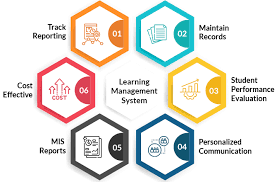
Modern LMS are equipped with a myriad of features designed to enhance the learning experience and streamline educational processes. Core functionalities typically include:
- Content Management: Enabling the creation, storage, and distribution of learning materials in various formats, such as text, video, and interactive media.
- Assessment and Evaluation: Facilitating the design and administration of quizzes, tests, and assignments, alongside tools for grading and providing feedback.
- Communication and Collaboration: Offering forums, chat rooms, and messaging systems to foster interaction between learners and educators, as well as among peers.
- Tracking and Reporting: Allowing educators to monitor learner progress, generate performance reports, and identify areas needing intervention.
- Customization and Personalization: Supporting the tailoring of learning experiences to meet individual learner needs and preferences.
Benefits of LMS in online teaching include:
- Improved accessibility and flexibility: LMS offer anytime, anywhere access to course materials, catering to diverse learning styles and schedules.
- Enhanced communication and collaboration: Facilitates communication, collaboration, and community building among instructors and students.
- Streamlined assessment and feedback: Centralized platforms reduce administrative burden and enhance timely feedback.
- Data-driven decision-making: Analytics provide valuable insights, enabling informed decisions about teaching approaches and interventions.
- Centralised resource repository: LMS serve as a repository for all course materials, assignments, and communication, ensuring easy access.
4. Impact on Educational Practices

The integration of LMS into educational institutions and corporate training programs has ushered in a paradigm shift in how learning is approached and delivered. Key impacts include:
- Accessibility and flexibility. LMS enable learners to access course materials and participate in learning activities at their convenience, thereby accommodating diverse schedules and learning paces.
- Enhanced engagement. Interactive features and multimedia content within LMS contribute to a more engaging and immersive learning experience.
- Data-driven insights. The analytical capabilities of LMS provide educators with valuable insights into learner behaviors and outcomes, informing evidence-based instructional strategies.
- Scalability. LMS facilitate the delivery of education to a large number of learners across different geographical locations, supporting the democratization of education.
5. Popular LMS Platforms
The most popular Learning Management Systems (LMS) platforms widely used in educational institutions and corporate training environments include:
1. Moodle
- Open-source: Free to use and customizable, making it a popular choice for educational institutions.
- Features: Supports course creation, assignments, grading, forums, and multimedia content.
2. Blackboard Learn
- Widely Used: Popular in higher education institutions.
- Features: Comprehensive tools for course management, assessments, analytics, and mobile access.
3. Canvas by Instructure
- User-Friendly: Known for its intuitive interface and ease of use.
- Features: Course management, grading, communication tools, and integration with various third-party apps.
4. Google Classroom
- Integration: Integrates seamlessly with other Google services.
- Features: Streamlined assignment management, communication tools, and collaboration features.
5. Schoology Learning
- K-12 Focus: Widely used in primary and secondary education.
- Features: Course management, assessments, analytics, and social learning tools.
6. TalentLMS
- Corporate Training: Popular in corporate settings for training and development.
- Features: Course creation, progress tracking, assessments, and certifications.
7. Edmodo
- Social Learning: Combines learning management with social networking features.
- Features: Assignments, quizzes, communication tools, and parent-teacher collaboration.
8. D2L Brightspace
- Versatile: Suitable for both academic and corporate environments.
- Features: Course management, analytics, adaptive learning, and mobile access.
9. SAP Litmos
- Enterprise Focus: Designed for large organizations.
- Features: Course creation, reporting, compliance tracking, and mobile learning.
10. Adobe Learning Manager
- Multimedia Integration: Strong focus on multimedia content and interactive learning.
- Features: Course management, video conferencing, gamification, and mobile access.
Each of these platforms has its unique strengths and is tailored to meet different educational and training needs. The choice of an LMS often depends on specific requirements such as ease of use, customization options, integration capabilities, and cost.
6. Challenges and Considerations

Learning Management Systems are becoming indispensable instruments in the fields of education, corporate training, and skill development in the current digital era. But while these platforms have many advantages, they are not without challenges.
Here are the top 10 challenges you might face when managing an LMS:
1. Intuitive User Experience (UX)
Challenge: Not all LMS platforms are user-friendly. A complex interface can deter users, impacting learning or training outcomes.
Solution: Regularly collect feedback from users and make necessary adjustments. Choose an LMS with an intuitive interface or invest in customizing it to suit your audience's needs
2. Integrating with Other Systems
Challenge: An LMS might need to be integrated with other tools such as HR systems, email platforms, or third-party apps. Integration challenges can arise, leading to disrupted functionality.
Solution: Opt for LMS platforms that support API integrations or built-in connectors for popular tools. Regularly update and test integrations for smooth operations.
3. Keeping Content Relevant and Updated
Challenge: Over time, content can become outdated or irrelevant, diminishing the learning experiences' value.
Solution: Periodically review and update courses. Encourage content creators to remain updated with the latest trends in their domain. Create a content calendar or schedule for regular reviews
4. Scalability Concerns
Challenge: As organizations grow, the LMS might not be equipped to handle an increased number of users, leading to performance issues.
Solution: Choose an LMS that offers scalability features. Cloud-based LMS platforms often provide the flexibility to scale according to changing needs
5. Technical Glitches and Downtimes
Challenge: Technical issues can lead to downtimes, impacting the learning process.
Solution: Regular maintenance, timely updates, and having a dedicated technical support team can mitigate these issues. Also, select an LMS with a good track record of uptime.
6. Data Security and Privacy
Challenge: With rising cyber threats, ensuring the security of users' data and content becomes a priority.
Solution: Opt for platforms with strong encryption, two-factor authentication, and regular security audits. Stay updated with global data protection regulations and ensure compliance.
7. Tracking and Reporting Limitations
Challenge: If the LMS doesn't offer comprehensive tracking and reporting features, assessing the effectiveness of the training becomes difficult.
Solution: Choose an LMS that provides detailed analytics on user engagement, course completion rates, and feedback. Utilize third-party analytics tools if needed.
8. Mobile Accessibility
Challenge: With the rise of mobile learning, an LMS that isn't mobile-responsive can hinder user engagement.
Solution: Ensure the LMS supports mobile accessibility. Offer mobile apps or ensure web responsiveness to cater to users on the go.
9. Customization Restrictions
Challenge: Every organization has unique needs. An LMS that doesn't allow customization might not align with specific requirements.
Solution: Opt for platforms that support modular designs and allow third-party integrations. This enables the addition of custom features and functionalities.
10. Cost Management
Challenge: Maintaining an LMS can become expensive, especially with growing needs.
Solution: Analyze the return on investment (ROI) regularly. Opt for subscription-based models or open-source platforms, which might be more cost-effective in the long run (Next Generation eDucation, 2023).
Thus, despite their numerous advantages, the implementation and utilization of LMS are not without challenges. Issues such as digital divide, user resistance, data privacy, and the need for ongoing technical support must be addressed to maximize the effectiveness of LMS. Furthermore, the quality of instructional design and the pedagogical approaches employed within LMS are critical determinants of their success.
7. Conclusion
As educational institutions and organizations continue to embrace digital transformation, Learning Management Systems (LMS) are poised to play an increasingly central role in the future of education. This Lesson provided an overview of LMS, exploring their historical development, key functionalities, impacts on educational practices, and the challenges associated with their use. By understanding the intricacies of LMS, educators and administrators can better leverage these systems to create more effective, inclusive, and engaging learning environments.
This Lesson explored various aspects of Learning Management Systems, laying the groundwork for further discussions on specific LMS platforms, implementation strategies, and best practices.
The Lesson also underscored the importance of addressing the challenges associated with LMS use. These challenges, ranging from technical issues to user resistance, must be thoughtfully managed to fully realize the potential of LMS. Through a detailed analysis of these challenges and potential solutions, educators and administrators can develop strategies to overcome obstacles and enhance the efficacy of LMS.
In conclusion, the evolving landscape of education necessitates a deep understanding of Learning Management Systems. By examining their development, functionality, and implementation, this Lesson aims to provide a foundation to navigate the digital transformation of education with confidence and foresight.
8. References
Kapadia, V. (2024). The History and Evolution of Learning Management Systems. https://www.gyrus.com/blogs/the-history-and-evolution-of-learning-management-systems/
Next Generation eDucation (2023). Top 10 Challenges of Managing a Learning Management System (LMS)https://www.linkedin.com/pulse/top-10-challenges-managing-learning-management-system-lms-greenlms-fv0tf/
Paulsen, M. F. (2003). Experiences with learning management systems in 113 European institutions. Journal of Educational Technology & Society, 6(4), 134-148.
Sankey, M. D., & Marshall, S. J. (2023). Perspective chapter: the learning management system of 2028 and how we start planning for this now. In Higher Education-Reflections From the Field-Volume 2. IntechOpen.
Turnbull, D., Chugh, R., & Luck, J. (2020). Learning management systems, an overview. Encyclopedia of Education and Information Technologies, 1052-1058.
Weller, M. (2023). The Rise and Development of Digital Education. In Handbook of Open, Distance and Digital Education (pp. 1-17). Singapore: Springer Nature Singapore.
Zawacki-Richter, O., & Jung, I. (Eds.). (2023). Handbook of Open, Distance and Digital Education. Springer.